A CD ladder is one of the easiest ways to earn more interest while still getting regular access to your money. I’ll walk you through how it works, how to set one up and how to time it around your family’s bigger expenses.
If you’ve ever had a car repair land the same month as the car insurance bill, you know your savings has two jobs. It needs to earn something, and it needs to be there when you need it.
For years, I kept my savings in a regular account at a big bank, and I’m kicking myself over how much interest I missed out on. My money was earning pennies. I eventually switched to a higher-interest savings account, which helped, but I really wish I’d tried CD laddering sooner.
CDs (certificates of deposit) can sometimes earn even more than high-yield savings by locking in a rate. The catch is that your money is tied up until the CD matures. That’s where a CD ladder comes in. Instead of putting all your savings into one CD, you split it across several CDs that mature at different times, so part of your money frees up every few months.
Why Families Build CD Ladders
Say you have $12,000 in savings. You could split it into four $3,000 CDs with 3-, 6-, 9- and 12-month terms. Every three months, one CD matures, and you get $3,000 plus interest. You can spend it, or reinvest it in a new 12-month CD so the ladder keeps going.
This works especially well for bills you can see coming, like insurance premiums, back-to-school costs, vacations, or a planned home project. Time a CD to mature right before the bill is due, so the money’s ready when you need it.
Longer CDs often pay higher rates, but not always. Sometimes a 6-month CD beats a 2-year one. Either way, only lock money into a longer term if it matches when you’ll actually need it.
An Example CD Ladder That Pays Out Every 2 Months
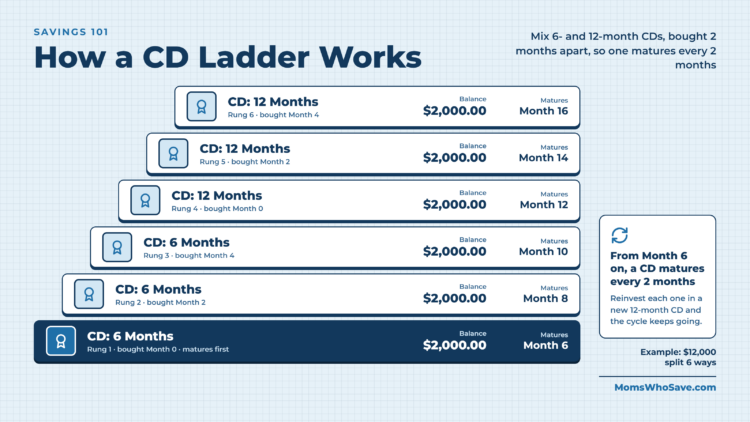
Want money available even more often? The ladder in this graphic mixes 6- and 12-month CDs, bought two months apart. With $12,000 split into six $2,000 CDs, you buy two CDs at the start, two more at Month 2 and the last two at Month 4. Starting at Month 6, one CD matures every two months. Reinvest each one in a new 12-month CD, and it keeps going. While you’re waiting to buy the later CDs, keep that money in a high-yield savings account so it’s still earning.
Start With Your Family’s Calendar
Before you open a single CD, grab a calendar and jot down the big expenses you expect in the next year, with a rough amount and a due date for each. Think taxes, sports fees, holiday spending, a vacation or a home improvement project (I have plenty of those).
Then match each expense to a CD. A $2,000 payment due in six months fits a 6-month CD. Money for next year’s bathroom remodel can sit in a longer CD and mature just before the contractor needs paying.
Keep Your Emergency Fund Separate
This one’s important. Don’t put your emergency fund in CDs. If the furnace stops working or you’re hit with a large medical bill, you’ll need that money right away. Pulling it out of a CD early usually means paying a penalty that can wipe out some or all of the interest you earned. Keep emergency money in a high-yield savings account.

Comparing CD Rates
Building a ladder means comparing several CD terms at the same time. You might need three-month, six-month, nine-month, and twelve-month accounts.
CD rates vary a lot from bank to bank. One bank might have a great 6-month rate, while a credit union across the country beats everyone on 12-month CDs. Checking them one website at a time can be difficult and time-consuming.
Comparison sites can save you a lot of clicking. You can compare top CD rates nationwide, filtering by term, so you can see what each rung of your ladder might earn.
Start by choosing the maturity dates you need. Then, compare available APYs, and shortlist institutions offering the best terms. Check minimum deposits, early withdrawal penalties, and renewal conditions.
Be sure to confirm current rates and account details directly with each institution before depositing any money. Always keep in mind, that although a high rate matters, it should never outweigh your family’s actual need for access to your money.
Setting Up and Keeping Track of Your Ladder
Decide how often you want money to come free, such as every two, three, or six months. It’s fine to use different banks for different rungs to get the best rate on each term. Just stay within the insurance limit: FDIC (banks) and NCUA (credit unions) cover up to $250,000 per depositor, per institution, per ownership category.
Keep a simple list or spreadsheet with each CD’s bank, amount, rate and maturity date. Then set a phone reminder a few days before each CD matures. Many CDs renew automatically at whatever rate the bank is offering, so you’ll want to decide ahead of time whether to spend the money, reinvest it or move it to savings.
CD interest counts as taxable income for the year it’s credited to your account, even if you leave it in the CD. Your bank will send you a 1099-INT.
Review your ladder once a year, or anytime life changes, like a new baby, a job change or a move.
If your income isn’t predictable, shorter terms like 3 or 6 months may make more sense than 1-year CDs. You might earn a little less, but your money frees up sooner. Check in on your ladder every few months as your income and expenses change, and compare rates again before you reinvest.
CD Ladder Mistakes to Avoid
- Putting your emergency fund in CDs
- Letting a CD auto-renew into a lower rate or a term you didn’t want
- Going over the $250,000 insurance limit at a single bank
- Picking the highest rate even when the maturity date doesn’t match when you’ll need the money
- Forgetting that CD interest is taxable, even if you leave it in the account

Is a CD Ladder Right for Your Family?
A CD ladder is a simple way to earn more on money you know you’ll need later, without locking it all up at once.
You don’t need a complicated setup to start. Even three or four CDs give you a good foundation, and you can add rungs as your savings grow. Just keep your emergency fund separate, know the penalty rules, and set reminders so you’re ready when each CD matures.
I learned the hard way that savings sitting in a regular bank account barely grows. A CD ladder is an easy fix, and it’s one I wish I’d tried years ago.
Have you ever tried a CD ladder, or is your savings still sitting in a regular bank account? Tell me in the comments!
Also read:
Boost Your Budget: 5 Expenses to Cut Out Now to Put Money Back in Your Pocket
How to Save Money on Your Family Car Insurance: 8 Tips
What’s Your Savings Style? Take the Quiz
You can find MomsWhoSave on Facebook, Instagram, Pinterest, and Twitter. Follow us to get our latest updates.
Don’t miss a thing! Subscribe to MomsWhoSave’s newsletter.
Leave a Reply