Last updated on September 13th, 2026
Getting a child to sit down and practice math used to mean a stack of worksheets and often a lot of frustration, but things have changed. When you know where to find the best math apps for kids, boring math drills turn into a game your child actually asks to play–and most of these apps cost less than a single tutoring session. Some are even free.

Math learning apps have come a long way, and today’s best options feel more like a favorite game than a study session. If you’re a parent trying to shore up basic math skills without adding to the homework battle, you’re in the right place. We’ve rounded up the top math apps for kids. These are the ones we would recommend to our own families, starting with a story-driven pick. We looked at price, age fit, and whether each one builds real math skills or just fills time.
A quick note before we get started. No app replaces you. But the right one gives your child regular math practice that feels like play, because teaching math at home doesn’t have to be a battle.
How to choose math apps for kids that actually stick
Not every app deserves a spot on your child’s tablet. A few things separate the best math apps from the ones that get deleted in a week, and this has less to do with flashy graphics than you might think.
Match the app to your child’s skill level and grade level
The fastest way to lose a child’s attention is to pitch problems that are too hard or too easy. Look for apps that align with your child’s skill level and grade level, and ideally let you set the difficulty yourself. It’s even better if the app adjusts the difficulty as your child improves, so the challenge grows with them.
Look for a free version you can try before you pay
You don’t need to spend a dime to find out whether your child clicks with an app. Plenty of options offer a free tier or a trial. Free apps can provide great value for daily practice, and trying first saves you from a subscription your child quickly abandons.
Check that it builds real math fluency, not screen time
The point is progress. The best math apps for kids reinforce math facts and build math fluency through short, repeated sessions, not passive watching. Math apps should provide immediate feedback so your child learns from a mistake right away. And apps should offer progress tracking for parents, so you can see what’s clicking and what needs work.
One more thing. Math apps for children often use gamification, rewards, and characters to keep kids coming back. That isn’t necessarily a gimmick. For some children, turning math practice into a game can make it much easier to stick with, and math games that reward effort can make practice feel less intimidating.
The top math apps for kids, ranked for families
Here are the best math apps for kids in 2026, chosen for how well these math games mix fun with real learning. We put value for the money front and center, because that’s what we do here.
1. MathHero: best story-driven math game for ages 5 to 10
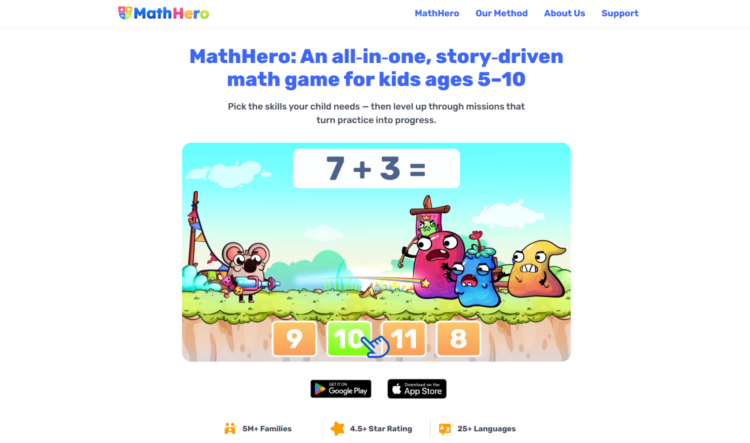
MathHero is our top pick, and it’s the one we would hand a reluctant learner first. It is a story-driven math game for kids ages five to 10, roughly kindergarten through elementary school. Your child plays a real adventure, rescuing characters and collecting coins and gear, and they move the story forward by solving short sets of math facts. Math is the action of the game, not a gate that blocks the fun.
The topics are the core of early math: addition and subtraction within 10, 20, 100, and 1000, plus times tables and division. MathHero doesn’t teach counting or number recognition from scratch, so your child should already know their numbers before starting. What it does brilliantly is turn practice into something kids want to do. As one parent put it, their son “corrected me and said it’s not work, it’s a game.”
Here is what sets it apart for parents. You’re in control. MathHero gives you fine-grained, selectable math operations, so you can switch on only the times tables your child is stuck on, say the sevens and nines, adjust the monster speed, and choose typed answers or multiple choice. Siblings at different levels can share the same game. That kind of control is rare, and it keeps families around.
On price, MathHero is free to play, and not a stripped demo. The entire game can be completed for free with no ads and no locked content. The only limit is pace: five levels per day. But truthfully, that cap works in your favor, because short daily sessions are exactly how math practice sticks. A subscription with a free trial removes the daily limit when your child wants more.
Best for: families who want a real math game, not a worksheet in disguise, with parent controls that fit each child.
2. Khan Academy Kids: best free math app for early learners
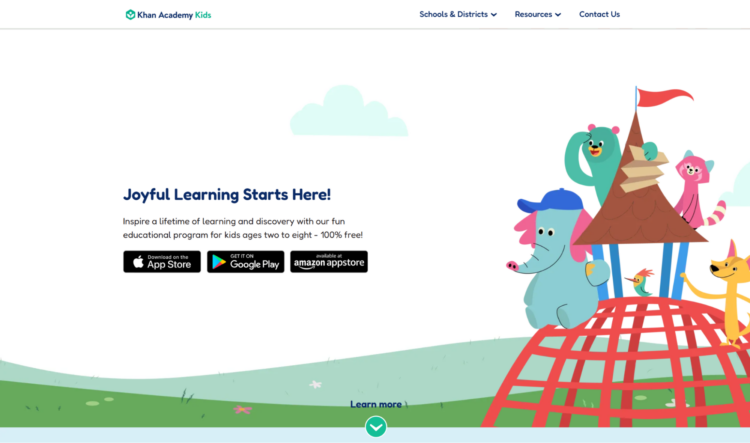
Khan Academy Kids is hard to beat on price because it’s completely free with no in-app purchases. It’s designed for ages two to eight and offers personalized learning paths that adapt as your child grows. Beyond math, it folds in reading and social skills, and it leans on friendly characters and instructional math videos to introduce basic math concepts. For a free option aimed at young learners, it offers a lot of content.
Best for: budget-conscious parents of preschool and early elementary school students who want conceptual understanding.
3. Prodigy Math: best fantasy-based math game for older kids
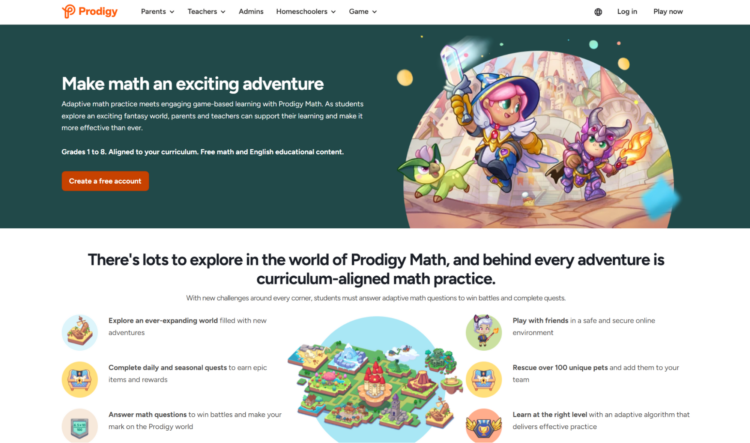
If your child is drawn to creature-battle games, Prodigy Math is a fantasy-based math game where kids cast spells by answering math problems. It covers over 1,500 skills from 1st to 8th grade, so it grows with your child right into middle school. A parent connect app lets you follow student progress and set goals to motivate students at home. The game is free, while paid memberships add extra features and rewards. The Core math membership is $9.95 per month, or $58.95 per year when billed annually.
Best for: older elementary and middle school students who love adventure and need something that scales up in grade level.
4. SplashLearn: best for curriculum-aligned practice
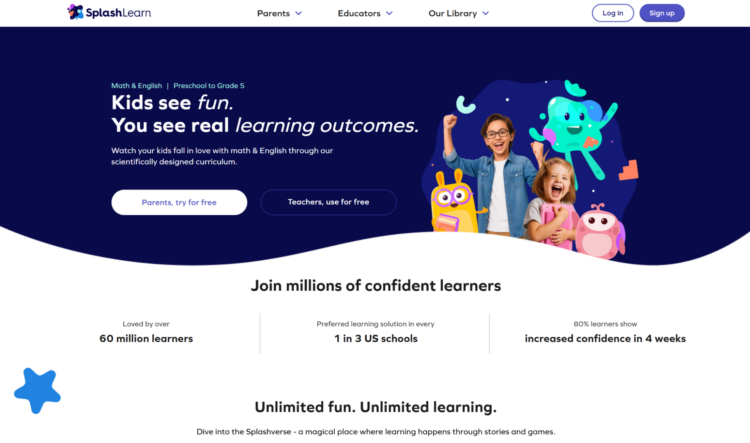
SplashLearn, once known as Splash Math, is a heavyweight for structured practice. SplashLearn offers more than 4,000 learning games and around 10,000 printable worksheets for Pre-K through Grade 5. Splash Math built its name on making drills feel like play, and the content is curriculum-aligned, mapping to what your child sees in class. It uses interactive games and virtual manipulatives to make abstract ideas concrete, and its math games walk kids through thousands of math problems without the groans. The mix of games and practice exercises keeps drills from feeling like drills.
Best for: parents looking for personalized math instruction and measurable progress, budget permitting.
5. Elephant Learning: best for accelerated math mastery
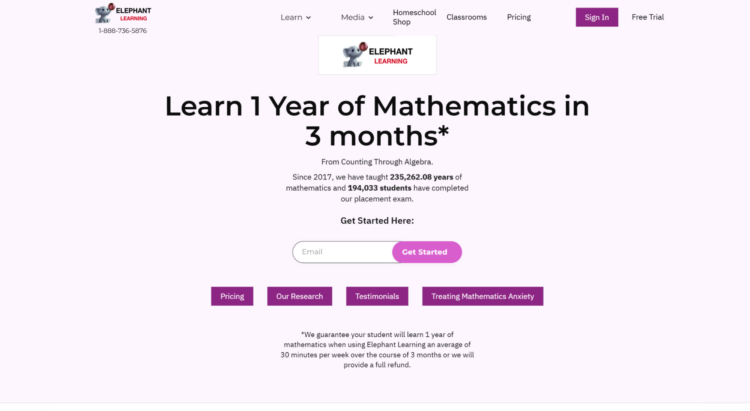
Elephant Learning takes a more intensive approach to math practice. The company says children can learn a year’s worth of math in three months with about 30 minutes of use per week. It delivers personalized instruction that meets kids at their level and focuses on math mastery. The downside is the price. Elephant Learning costs $50 per month for one student, which makes it the splurge here, so weigh the cost against what you’re hoping your child will get from the program.
Best for: parents looking for personalized math instruction and measurable progress, budget permitting.
6. Monster Math 2: best adventure math game for K–5
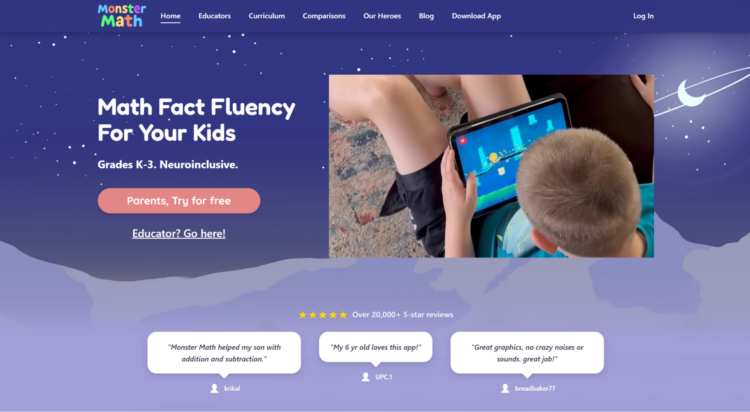
Monster Math 2 turns math practice into an adventure, with kids solving problems as they explore different worlds and characters. It covers more than 67 math skills, including addition, subtraction, multiplication, division, fractions, decimals, factors, multiples, prime numbers, and basic geometry. The app is designed for students in kindergarten through fifth grade, with skill levels that can be adjusted to match each child’s ability.
Parents can also see detailed progress reports, making it easier to tell which skills your child has mastered and where they may need more practice. The free version offers access to some content, while a subscription unlocks the full app and includes a seven-day free trial.
Best for: K–5 students who enjoy adventure games and need extra practice across a range of math skills.
7. Marble Math Junior: best for young kids and hands-on learners
Marble Math Junior is built for young kids just getting comfortable with numbers. Players roll a marble through mazes to solve problems, which turns basic math concepts into something visual and hands-on. The colorful visuals and interactive style suit little ones who learn by doing, and the math activities stay manageable enough not to frustrate. Check the exact age range on the app store before you buy, since Marble Math Junior targets the younger end of elementary. Marble Math Junior is currently $3.99 (a one-time purchase), making it one of the more affordable paid options on this list.
Best for: preschool and early elementary-level kids who benefit from visual, hands-on learning.
8. DragonBox: best for algebra and logical thinking
DragonBox takes a different approach to math, turning algebra and geometry into puzzles kids can solve as they play. Along the way, kids build logical reasoning and problem-solving skills, a good fit for kids who like a brain teaser. Older kids can move on to the more advanced algebra and geometry titles.
Best for: curious kids ready to grow their problem-solving skills and get an early, painless intro to algebra.
9. Moose Math: best for preschoolers and basic skills
Moose Math engages preschoolers with colorful mini-games set in a friendly town. Kids run a smoothie shop and build with numbers, picking up counting, addition, and basic math skills along the way. It’s bright, forgiving, and so much fun that young learners forget they are practicing. It’s an easy, free way to get started with basic math skills.
Best for: young learners and kindergarteners taking their first steps in math.
10. IXL: best for personalized math instruction and diagnostics
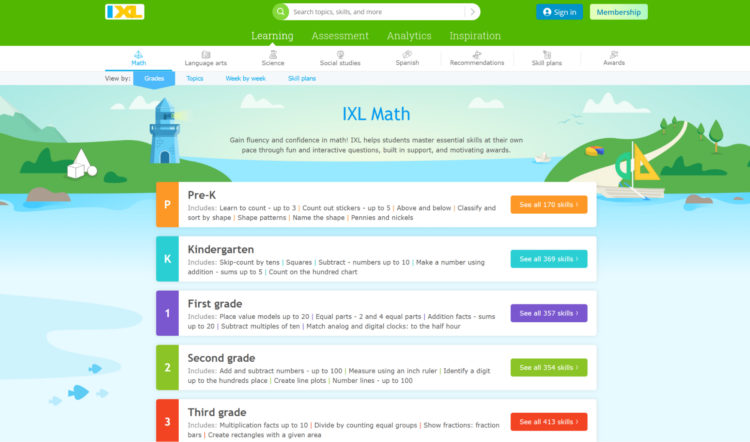
IXL is the app teachers reach for, and it shows. IXL provides math exercises for students from pre-K to 12th grade and gives personalized skill recommendations based on diagnostics, so students complete exactly the practice they need. It covers every major math topic, which means it works for early elementary students and high school students alike at any skill level. The math instruction is thorough, if a little more workbook than game. IXL offers several membership options, with pricing depending on the subjects and billing plan you choose.
Best for: families who want serious, personalized instruction across every grade level.
11. DoodleMath: best for adaptive, self-paced learning
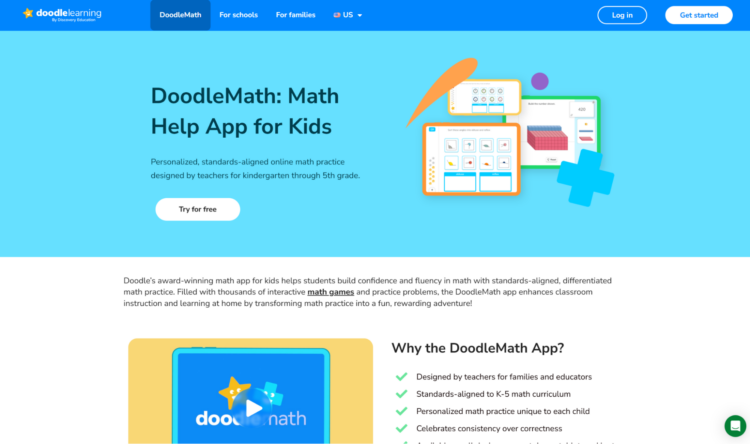
DoodleMath tailors math content based on students’ strengths and weaknesses, so every child gets a path that fits. Its adaptive-learning engine supports self-paced learning, letting kids work at their own pace and build independent learning habits. Parents can watch student progress through a companion app. DoodleMath costs $10.99 per month for one child or $94.99 per year, with a family plan available for up to six children for $18.99 per month or $179.99 per year. Paid plans start with a 7-day free trial.
Best for: kids who thrive with adaptive learning and steady, self-guided progress.
Free versus paid math apps: what is actually worth it?
Here’s the honest breakdown.
A free app is often plenty. Khan Academy Kids costs nothing, and MathHero lets your child finish the whole game free at five levels a day. For most families, that daily rhythm is the sweet spot for building basic math skills without spending anything.
Paying makes sense when you want more volume or a specific feature. If your child races through five levels and wants more, or you want a giant bank of practice exercises, a subscription or the occasional in-app purchases can be worth it. Just skip apps that lock core learning behind a paywall, and read the pricing before you tap.
The biggest advantage of a good math app is simple: if your child enjoys it, they’re more likely to keep coming back.
How to help your child get the most from math apps
Even the best math apps for kids work better with a little help. A few simple habits can make practice more effective.
Keep sessions short and regular. Ten to 15 minutes a day is easier to stick with than a marathon once a week.
Let your child pick the character or story. Giving kids some choice can make practice feel more personal and give them another reason to come back.
Check in now and then. You don’t have to sit beside your child for every session, but celebrating progress or helping with a tricky problem can make the experience more rewarding.
Talk about math away from the screen. Ask your child to explain how they solved a tricky problem. Talking through the process can help reinforce what they are learning.

Frequently asked questions
What are the best math apps for kids in 2026?
Our top math apps for kids are MathHero for story-driven practice, Khan Academy Kids for a free option, Prodigy Math for older kids, and SplashLearn for curriculum-aligned work. MathHero leads the list because it turns core math skills into a game kids ages five to 10 actually want to play.
What is the best free math app for kids?
Khan Academy Kids is fully free with no in-app purchases, and MathHero is free to complete at five levels per day with no ads. Both give young learners real practice without a subscription.
Do math apps really help kids learn?
Yes, when used regularly. Interactive games can help kids master the basics, and short daily sessions build lasting fluency. Look for math apps that provide immediate feedback, so your child can learn from mistakes right away. Progress tracking helps kids learn from mistakes and parents can follow along and see where their child may need more practice.
What age should kids start using math apps?
Some apps for kids start as young as age two, like Khan Academy Kids, while others are designed for preschool and early elementary students. Story-driven options like MathHero fit kids ages five to 10 who already know their numbers and are ready for real math topics.
Pick one, hand over the tablet, and watch a math-hater turn into a kid who asks for one more level!
Has your child used any of these math apps? Leave us a comment.
Also read:
How Parents Can Help Children Who Struggle with Homework
Best Fun and Free Educational Sites for Kids: Dozens of Links to Keep Your Kids Learning
You can find MomsWhoSave on Facebook, Instagram, Pinterest, and Twitter. Join us for updates.
Don’t miss a thing! Subscribe to MomsWhoSave’s newsletter.
Leave a Reply